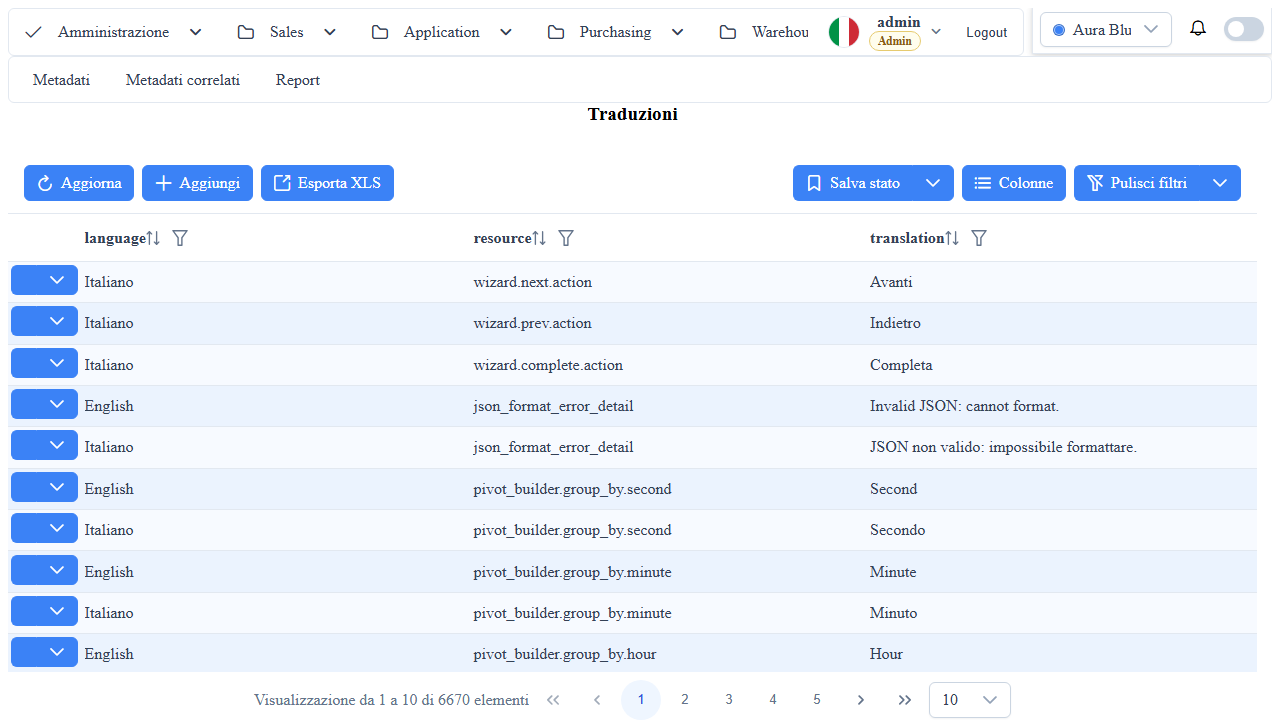
Overview
Interface Translations
Centralized management of framework UI translations on the #/_wuic_translations/list route.
Scope
- Interface dictionary for text keys (
translation key) used in components. - Variants per language/culture (e.g.,
it-IT,en-US) with controlled fallback. - Coverage of labels, tooltips, messages, button captions, menu texts, and metadata editor.
Main Client-Side Features
- Translation loading at startup via
TranslationManagerService. - Runtime key -> value resolution with fallback on current language and default.
- Direct integration with
translatepipe in Angular templates. - UI update after metadata changes without frontend rebuild.
- Support for new keys on the fly (when metadata and routes are updated).
Main Server-Side Features
- Translation storage in a dedicated metadata table (
_wuic_translations). - AsmxProxy API for reading/updating translation packages.
- Authorization policy: translation modification limited to enabled users/roles.
Recommended Operational Flow
- Insert/update keys in
#/_wuic_translations/list. - Verify the key in the UI (
{{ 'my_key' | translate }}or runtime equivalent).
md_props_bag
For this route, mandatory extensions are normally not needed, but operational options in the table md_props_bag are useful.
Snippet 1JSON
{
  "serverProperties": {
    "queryOptimization": {
      "enabled": true,
      "countPolicy": "skipWhenPaged",
      "sqlServerHint": "recompile"
    }
serverProperties.queryOptimization.enabled: enables the optimized query branch server-side.countPolicy=skipWhenPaged: avoids total count when not needed; client-side pager remains stable during paginated navigation.sqlServerHint=recompile: useful on translation datasets with highly variable filters.endpoint.*: optional, used only if you want to force a specific source different from the default metadata-provider.
Best Practices
- Keep keys semantic and stable (
menu.sales.orders) instead of hardcoded texts. - Avoid semantic duplications between nearly identical keys.
- Manage language fallback explicitly on critical keys (error messages, confirmations, warnings).
- Align translation naming with metadata/feature naming for easier maintenance.
Screenshot