Overview
Scheduling
Operational scheduling, planned jobs, and temporal orchestration.
Screenshot Reference (User Manual)
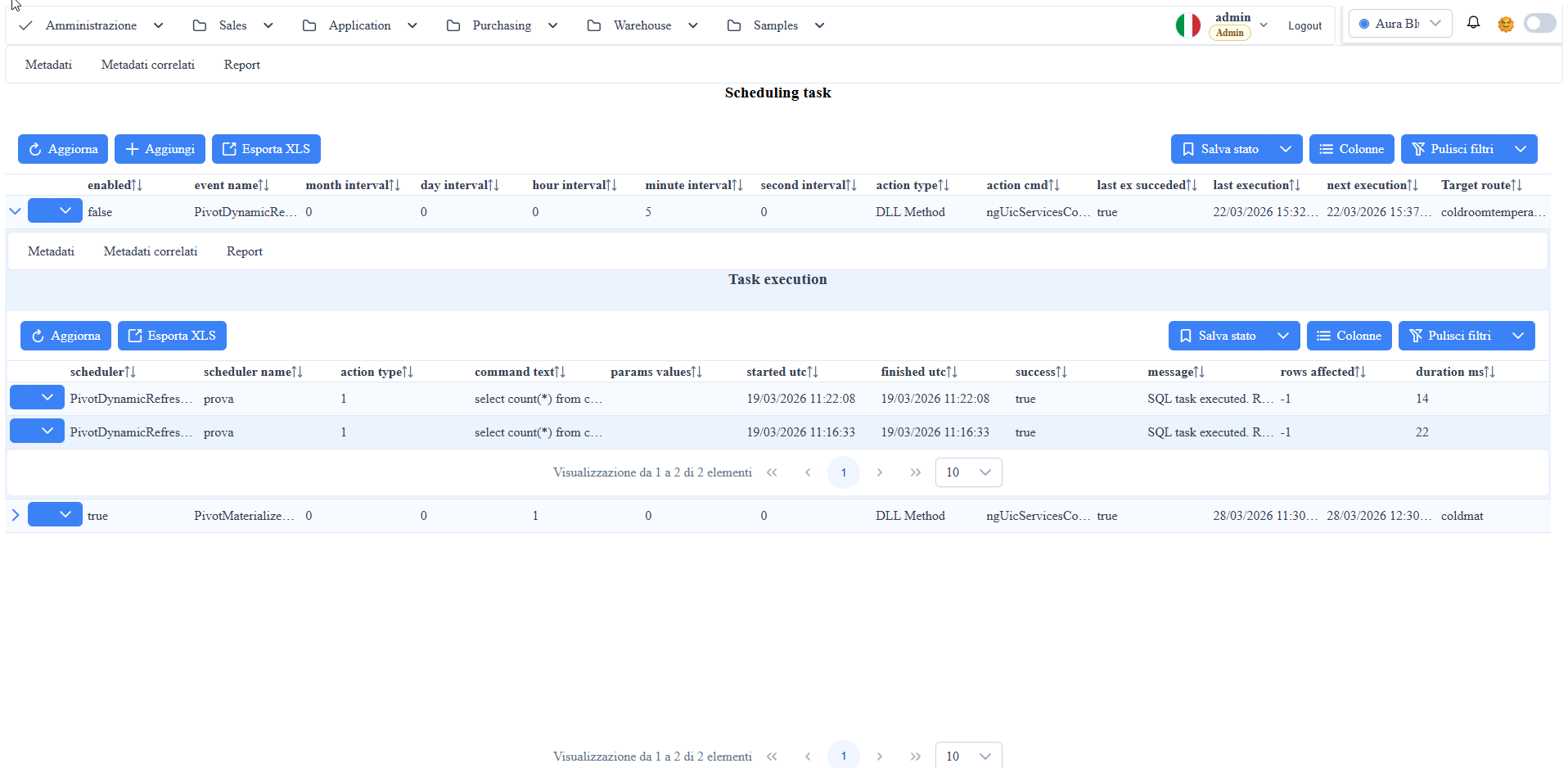
manual__scheduling__01.png: scheduled task list with intervals, action type, and last/next execution status.
Scheduled Task Management
The Scheduler module executes planned jobs by reading the configuration from the dbo.scheduler metadata table and tracking outcomes in dbo.scheduler_execution.
Description:
the service periodically checks due tasks, executes the command, and updates execution states.
Runtime flow:
- periodic backend poll (Hosted Service) on tasks with
enabled = 1andnext_execution <= now. - task execution based on the configured action type.
- outcome recording (
ok/error, duration, message) toscheduler_execution. - update of
last_execution,next_execution,last_ex_succededfields.
scheduler Table Metadata (Main Fields)
id: task identifier.enabled: enables/disables the job.event_name: logical name of the scheduled event.month_interval,day_interval,hour_interval,minute_interval,second_interval: combinable intervals used to calculate the next execution.action_type: operation type executed by the job.action_cmd: command associated with the action type.last_execution: last execution timestamp.next_execution: next planned execution timestamp.last_ex_succeded: last outcome flag (true/false).
Action Types (action_type) and Meaning
Snippet (quick map):
1 | sql -> SQL / stored procedure2 -> web service3 -> .NET method (Namespace.Type.Method)4 -> mailing/distribution list
1orsql: executes SQL/stored procedure.2: invokes a web service endpoint.3: invokes a .NET method (Namespace.Type.Method) via reflection.4: executes a mailing/distribution list action.
Execution Tracking (scheduler_execution)
For each run, at least the following is recorded:
- reference to the scheduled task.
- start and end date/time.
- final status.
- optional error message or summary output.
This enables operational auditing and job troubleshooting.
Relevant AppSettings
Description:
these keys govern the polling cycle, per-cycle concurrency, and SQL timeouts.
Snippet:
"Scheduler.Enabled": true"Scheduler.PollSeconds": 15"Scheduler.MaxTasksPerCycle": 20"Scheduler.RetryDelaySeconds": 60"Scheduler.SqlCommandTimeoutSeconds": 300
Enabled: enables/disables the backend scheduler.PollSeconds: polling frequency for due tasks.MaxTasksPerCycle: maximum number of tasks processed per cycle.RetryDelaySeconds: minimum delay before retry after error.SqlCommandTimeoutSeconds: timeout for scheduler SQL commands.
Result:
- predictable and controllable scheduling per environment;
- simple tuning of frequency, throughput, and error robustness.
Screenshot