Overview
Data Translations
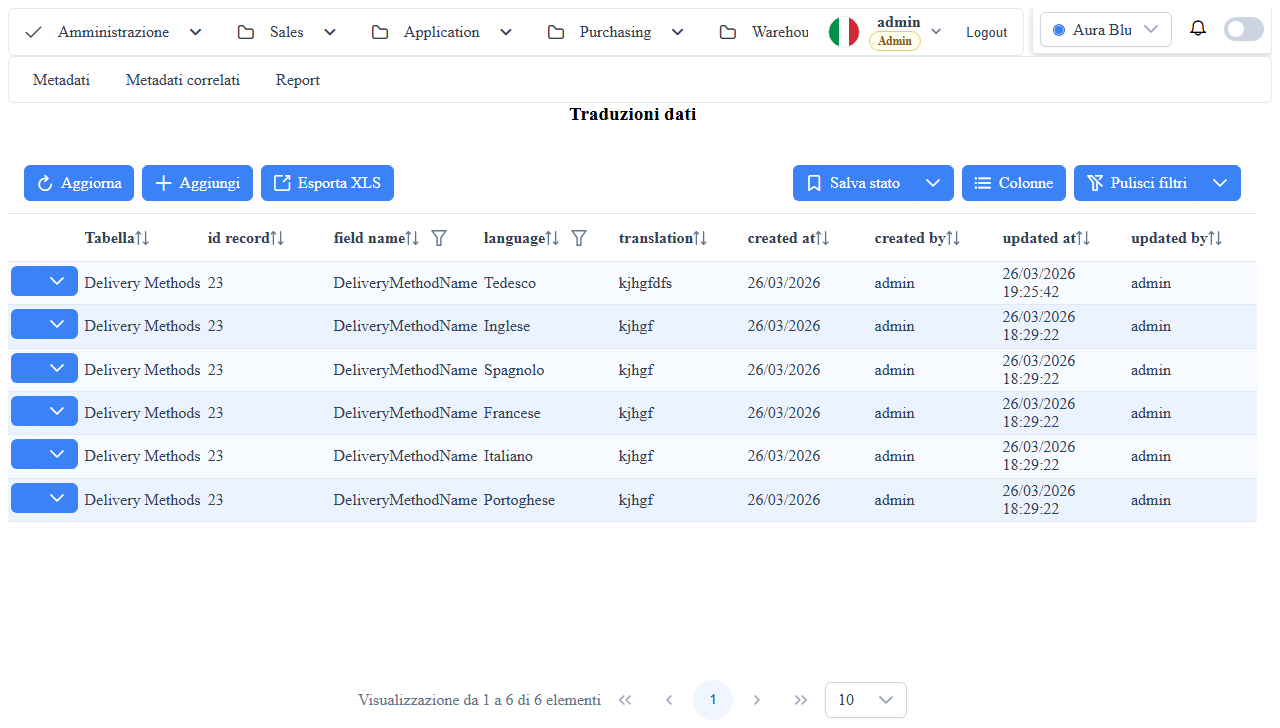
Record-level content translation on the #/_record_field_translations/list route for multilingual support of business data.
Scope
- Translations for field values on specific records (not just UI labels).
- Variant management per language on entity/table/column.
- Typical use: product descriptions, operational notes, commercial texts, content displayed in list/detail/report.
Main Client-Side Features
- Automatic rendering of the translated value when the user language changes.
- Fallback to the base record value when the specific translation is missing.
- Compatibility with list-grid, form/edit popup, data-driven archetypes, and report/export.
- Consistent update after saving/editing translations without component changes.
Main Server-Side Features
- Join/fetch of record-field translations in dynamic queries (
getFlatRecordData) when configured. - Persistence by composite keys (entity, record id, field, language).
- Transactional consistency between base value and translated variants.
- Authorization enforcement on data translation modifications.
Usage Pattern
- Insert translations in
#/_record_field_translations/list. - Correctly associate entity/record/field/language.
- Verify in the target route that the active language displays the translated value.
- When a translation is missing, verify fallback to the original value (baseline).
Global configuration (appsettings.json)
The feature is driven by the RecordTranslations section in appsettings.json (read server-side at bootstrap). When Enabled=true, the backend joins the translation table in getFlatRecordData and applies a fallback to the base value when no variant exists for the current language.
{
  "RecordTranslations": {
    "Enabled": true,
    "DefaultTableName": "_record_field_translations",
    "TranslationJsonFieldName": "translation_json",
    "DefaultLanguage": "it-IT",
    "FieldNames": []
Enabled: global switch. Iffalse, no join →getFlatRecordDatareturns only base values. The client uses this flag (exposed viaAuthConfig.recordTranslationsEnabled) to decide whether to reload the route on language change.DefaultTableName: SQL table that stores (entity, record_id, field, language) → translation. Convention:_record_field_translations.TranslationJsonFieldName: JSON column name where multiple translated fields per record coexist (alternative to the composite-key tabular model).DefaultLanguage: "base" language of records; used as fallback when the user's language has no variant.FieldNames: global list of fields candidate for translation (can be overridden per route viamd_props_bagbelow).
Changes to this section require an app restart (change impact = Restart in the AppSettings panel).
md_props_bag (per-route override)
Each route can have its own serverProperties.RecordTranslations block inside the metadata table md_props_bag (_metadati__tabelle.md_props_bag). Use it when a single table wants to:
- enable translations only for itself (even with the global flag off),
- disable translations only for itself (with the global flag on),
- override
DefaultLanguageor theFieldNameslist with a table-specific set.
{
  "serverProperties": {
    "RecordTranslations": {
      "Enabled": true,
      "DefaultTableName": "_record_field_translations",
      "TranslationJsonFieldName": "translation_json",
      "DefaultLanguage": "it-IT",
Resolution precedence (server-side): md_props_bag.serverProperties.RecordTranslations (if present) → appsettings RecordTranslations (global) → code default.
Effects on language change (client)
When Enabled=true (global or per-route override), on language change the client reloads only the datasource of the currently displayed route via getFlatRecordData — internal metadata datasources (styles, authorizations, etc.) are not reloaded because they do not vary per language. When Enabled=false, zero data re-fetches: labels are handled by the translate pipe which updates autonomously from _wuic_translations.
Client/Server Effects per Key Property
entity/table route: client routes the context; server filters the translation domain.record id: client maintains record binding; server resolves the target row.field name: client knows where to inject the translated text; server correctly maps the column.language code: client switches language immediately; server selects the correct variant.translated value: client displays localized output; server saves and returns a consistent payload.
Best Practices
- Define a single fallback policy (e.g., user language -> tenant default -> base value).
- Avoid duplicate translations for the same composite key.
- Track translation updates with audit (user/date) in enterprise environments.
- Always test edge cases: missing translation, unsupported language, deleted record.
Screenshot